
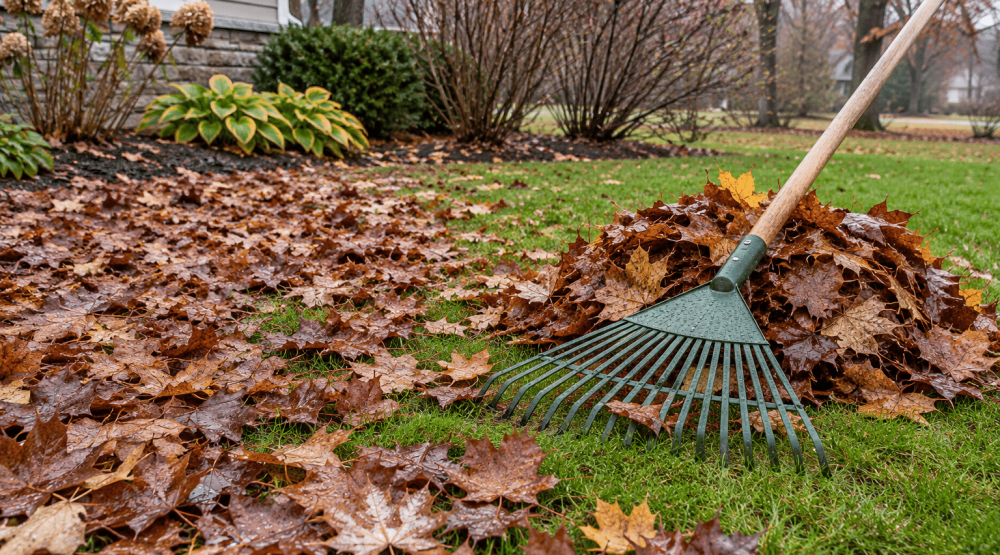
Leaving a thick, wet blanket of whole leaves on your lawn over winter can damage the grass underneath. The problem is the dense mat that blocks light and smothers turf—not every fallen leaf. A light scattering can often be mulched, while leaves in suitable garden beds can support soil health and wildlife.
For Chicago-area homeowners facing the last heavy leaf drop of November, the goal is to keep the lawn uncovered enough to stay healthy while putting useful organic material in the right place.
Why Thick Leaf Mats Can Harm Your Lawn
Whole leaves overlap and pack together after rain. Where that layer stays dense, it can block light from reaching the grass and leave turf smothered beneath it. Piles that remain until spring may reveal weakened or bare patches when they are finally removed.
Iowa State University Extension explains that leaves provide valuable habitat and organic matter, but unmanaged layers can block light and damage plants. Redistributing excess leaves helps retain the benefits without allowing a thick mat to form.
This is especially relevant where wind pushes leaves against fences, into corners, or beneath large trees. Inspect those collection points instead of judging the yard only from the driveway.
How Do You Know There Are Too Many Leaves?
Look at the condition of the leaf layer and the grass beneath it. Cleanup becomes a priority when:
- Whole leaves form an overlapping blanket that hides the turf.
- Wet leaves stick together in sheets.
- Piles collect repeatedly along edges or in low spots.
- Leaf fragments remain in heavy clumps after mowing.
There is no single leaf count that works for every yard. Leaf size, moisture, density, and mower performance all matter. The practical question is whether the grass remains visible and free of a smothering cover.
When Can You Mulch Leaves Into the Lawn?
A manageable layer of leaves can be chopped with a mulching mower while conditions are suitable. Small pieces settle between grass blades more readily than whole leaves. Work when the turf is firm and the leaves are reasonably dry; avoid mowing frost-covered or waterlogged grass.
After a pass, check the result. If clumps or a heavy cover remain, redistribute or collect the excess rather than repeatedly driving over soft ground. Iowa State’s lawn leaf-management guidance describes mulching as an option for returning organic matter to the soil.
Leaf mulching and grass cutting are related tasks, but the grass should not be scalped to process more leaves. Our article on the final mowing of the season in Chicago explains how to follow growth and avoid an excessively short cut.
Where Can You Leave Leaves Instead?
Leaves can have a useful place in the landscape. Existing leaf litter in appropriate beds and beneath shrubs provides habitat for overwintering insects. Collected leaves can also be composted or redistributed to suitable mulched areas.
Keep heavy accumulations away from plant crowns and avoid burying small plants. Leave room around tree trunks and woody stems. A bed should receive an amount that suits the plants and drainage; it should not become the dumping place for every leaf on the property.
Whole leaves can preserve habitat, while shredding helps material break down more quickly. Choose the method for the purpose of that area rather than treating every part of the yard the same way.
Do Not Forget Walkways and Drainage Routes
Leaves on the lawn are only part of a November cleanup. Gather leaves from steps, paths, and patios, and remove accumulations around accessible surface-drain openings. Wet leaves can make a walking surface slippery and conceal uneven pavement.
Keep collected material out of streets and storm drains. Check your municipality’s current yard-waste and leaf-collection instructions before setting bags or piles near the curb; collection methods and schedules vary across Chicago suburbs.
A Practical November Leaf-Cleanup Plan
- Start with access. Clear steps, entrances, and walkways.
- Check the lawn. Remove dense piles and wet mats.
- Mulch manageable amounts. Confirm that chopped leaves do not leave heavy clumps.
- Reuse appropriate material. Compost it or move it to suitable beds without burying plants.
- Inspect again after the next leaf drop. Trees do not all finish shedding at the same time.
Our broader fall cleanup guide explains how leaf work fits into the rest of your seasonal property care.
Get Help With Fall Leaf Cleanup
C.O. Landscaping & Natural Stone provides seasonal landscaping maintenance, including fall leaf and debris removal, for Chicago-area residential and commercial properties.
Contact C.O. Landscaping to discuss a cleanup plan that keeps heavy leaves off the turf and prepares your property for winter.